Money is the number one source of roommate conflict. Not dirty dishes, not noise at midnight, not different sleep schedules. Money.
The good news: most money fights come from unclear expectations, not actual disagreements about what's fair. Two roommates who sit down for 15 minutes and agree on a system almost never fight about money. Two roommates who just "figure it out as they go" almost always do.
Here's how to set things up so splitting expenses is painless from day one — or how to fix things if you're already mid-lease and running into friction.
Common Roommate Expense Mistakes
Before getting into solutions, it helps to understand what goes wrong. These are the patterns that lead to resentment:
- Not discussing money before moving in. It feels awkward, so people skip it. Then they spend months in a low-grade guessing game about who owes what.
- Trusting memory instead of tracking. You think you remember who paid for the cleaning supplies last month. You don't. Neither does your roommate. Now you're both convinced you paid more.
- Splitting everything 50/50 when usage isn't equal. One person has the master bedroom. One person works from home and uses more electricity. A flat 50/50 split sounds fair but often isn't.
- Letting small amounts slide until they add up. That $8 here and $12 there doesn't seem worth mentioning. Until three months later, one person has quietly covered $200 more and is starting to resent it.
- Sending payment requests without context. Getting a random $47 Venmo request with no explanation is confusing and feels aggressive. Always include what it's for.
What Expenses Should Roommates Split?
Not everything should be split. Have a clear understanding of which categories are shared and which are personal.
Always split:
- Rent
- Utilities (electric, water, gas, internet)
- Shared household supplies (toilet paper, dish soap, cleaning products, trash bags)
Split when shared:
- Groceries (only if you cook and eat together)
- Streaming subscriptions you both use
- Shared furniture or kitchen equipment
Never split:
- Personal food and snacks
- Personal subscriptions
- Personal toiletries (your shampoo, their face wash)
- Expenses from your guests
Tip: Create a shared list during your first week together. Write down everything you both agree is "shared." Revisit it after a month to adjust. This 5-minute exercise prevents months of ambiguity.
3 Methods for Splitting Roommate Expenses
1. The Spreadsheet Method
Create a shared Google Sheet or Excel document. Every time someone buys something shared, they log the date, item, amount, and who paid. At the end of each month, tally it up and settle the difference.
Pros: Completely transparent. Free. Everyone can see the full history at any time.
Cons: Requires discipline. Someone has to remember to log every purchase. It's easy to forget a $6 item here and there, and those gaps add up. After a few weeks of inconsistent logging, people tend to abandon it.
Best for: Two organized roommates who enjoy tracking things manually.
2. The Rotating Payer Method
Take turns buying shared items. "I got groceries this week, you get them next week." No tracking needed beyond remembering whose turn it is.
Pros: Dead simple. No apps, no spreadsheets, no math.
Cons: Only works if the expenses are roughly equal each time. If you spend $40 on your week and your roommate spends $120 on theirs, you're not really splitting evenly. Gets complicated with more than two roommates.
Best for: Two roommates with very similar spending habits who mostly just share weekly grocery runs.
3. The App Method
Use a bill-splitting or expense-tracking app. Log expenses as they happen (or scan the receipt), and the app keeps a running balance of who owes whom. Settle up whenever the balance gets high enough or on a set schedule.
Pros: Accurate. Low effort once set up. Receipt scanning means you have proof of every charge. Running balance means you don't have to do monthly math.
Cons: Everyone in the household needs to use it consistently. If one roommate never logs their purchases, the system breaks down.
Best for: Any roommate situation, especially with three or more people.
How to Split Groceries Fairly
Groceries are where most roommate splits get messy. Rent is a fixed number. Utilities come with a bill. But groceries? One person buys organic everything and the other is fine with store brand. One person eats twice as much. One person's "personal items" always seem to end up in the shared fridge.
There are three approaches, each with trade-offs:
Option A: Buy separately. Each person buys their own food. Cleanest solution. The downside is you miss out on bulk discounts, and you need separate shelf space. Works best when roommates have very different diets.
Option B: Split the whole receipt equally. One person shops, everyone splits the total. Simple, but unfair if one person loaded the cart with expensive items for themselves while the other just needed bread and eggs.
Option C: Scan the receipt and assign items. This is the fairest approach. Go through the receipt, mark shared items (milk, eggs, bread, cleaning supplies) as shared, and assign personal items (your specialty coffee, their protein bars) to the buyer. Apps like ReceiptSplit let you do this in seconds — scan the grocery receipt, tap items to assign them, and the app handles the math including tax and tip.
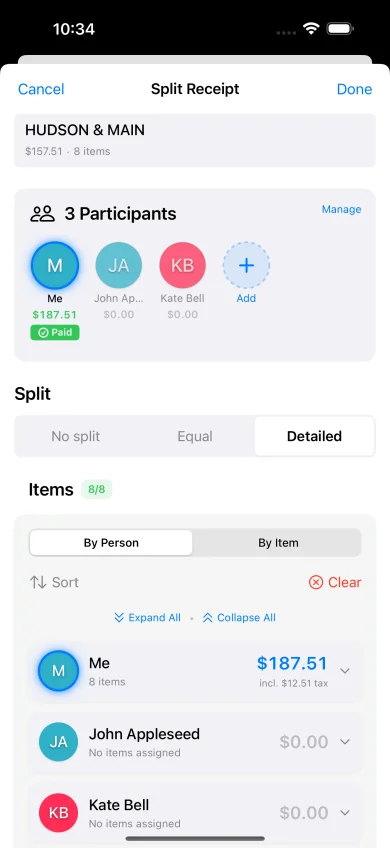
Practical tip: Agree on a short list of shared staples (milk, eggs, bread, butter, cooking oil) and split those automatically. Everything else gets assigned to whoever wanted it. This covers 80% of grocery situations without any debate.
Split grocery receipts in seconds
Scan the receipt, tap to assign items, and see who owes what. Tax and tip included automatically.
Download Free on the App StoreUsing an App to Track Shared Expenses
If you've tried the spreadsheet or rotating method and it didn't stick, an app is probably your answer. Here's why apps tend to work better over time:
- No manual data entry. Receipt scanning means you photograph the receipt and the app pulls out the items and prices. Takes about 10 seconds versus 5 minutes of typing into a spreadsheet.
- Running balance. You always know where things stand. No need to wait until the end of the month and do a bunch of arithmetic.
- Payment tracking. Log when someone pays, and the balance adjusts automatically. No more "I already paid you for that" disputes.
- Works offline. Good apps let you log expenses even without internet, which means you can scan a receipt right there in the store.
When choosing an app, look for: receipt scanning, running balance between participants, payment request generation (so you can send a Venmo or Zelle request with the right amount), and offline support.
Two solid options: ReceiptSplit is built specifically for scanning receipts and assigning items to people, which makes it particularly good for groceries and restaurant bills. Splitwise is great for ongoing balance tracking across many expense categories over time.
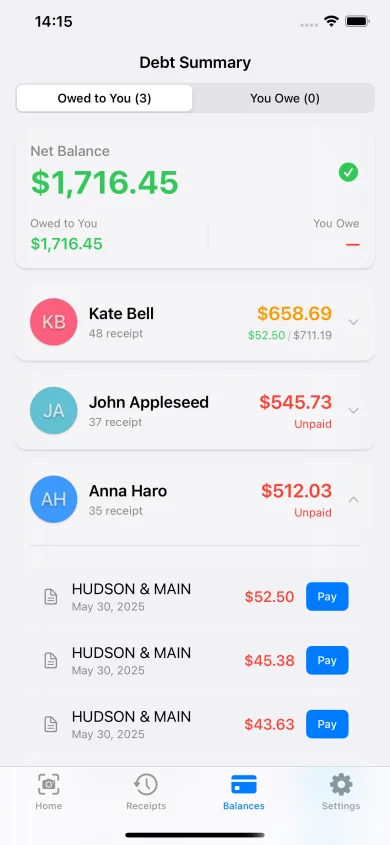
Tip: Pick one app and stick with it. The best system is the one everyone actually uses. Having half the expenses in one place and half in another defeats the purpose. For quick calculations when dining out together, our tip calculator lets you figure out each person's share in seconds.
Done with spreadsheets?
ReceiptSplit scans receipts, assigns items, and tracks who owes what. Free, no account required.
Download Free on the App StoreSetting Up a Roommate Expense Agreement
Whether you're about to move in together or you're already six months into a lease and things are getting tense, it's not too late to have the conversation. It takes about 15 minutes and covers five questions:
- How will we split rent? Equal? By room size? If rooms are different sizes, measure the square footage and split proportionally. This is the single most impactful thing you can agree on.
- How will we handle utilities? Most roommates split these equally, since it's hard to measure individual usage. If one person works from home full-time and the other is gone 10 hours a day, consider a slight adjustment.
- What groceries and supplies are shared? Make the list. Write it down. "Shared" means you both use it and both pay for it.
- How often do we settle up? Monthly is standard. Some people prefer biweekly. Set a recurring calendar reminder so nobody has to be the one to bring it up.
- What app or method will we use to track? Agree on one system and both commit to using it. A system only works if everyone participates.
Having this conversation once prevents dozens of awkward conversations later. It's not about distrust — it's about making money a solved problem so you can focus on actually enjoying living together.
For more background on how expense-splitting actually works and tips for using mobile payment services safely, the Consumer Financial Protection Bureau has a useful overview.
Frequently Asked Questions
How do you split rent when rooms are different sizes?
Calculate based on square footage. Measure each bedroom and divide the total rent proportionally by room size. For example, if rent is $2,000/month and one room is 150 sq ft while the other is 100 sq ft, the larger room pays $1,200 and the smaller room pays $800. Some roommates also factor in things like an attached bathroom or better natural light, but square footage is the fairest starting point.
Should roommates split groceries?
Only if you eat together regularly. If you cook and eat separately, it's simpler and fairer to buy your own food. If you share meals or staple ingredients, split those shared items and keep personal items separate. A receipt-scanning app can make this easy by letting you assign items to specific people.
How often should roommates settle up?
Monthly works for most roommates, usually timed with rent. If you have frequent shared expenses like weekly grocery runs, biweekly can prevent the balance from getting uncomfortably large. The key is consistency — set a recurring calendar reminder so nobody has to be the one to bring it up.
What if one roommate never pays on time?
Start by using an app with payment reminders so there's a clear, objective record of what's owed. If the problem persists, have a direct but non-confrontational conversation. Suggest a specific settle-up date each month (like the 1st or 15th). If it continues, consider switching to a system where everyone contributes to a shared fund upfront for common expenses.
What's the best app for roommate expenses?
It depends on your situation. Splitwise is great for ongoing balance tracking across many categories. ReceiptSplit is ideal if your main pain point is splitting shared receipts (especially groceries) item by item. The best app is the one everyone in your household will actually use consistently.
Track every shared expense
Scan receipts, assign items, and see exactly who owes what — no spreadsheets needed.
Download Free on the App Store